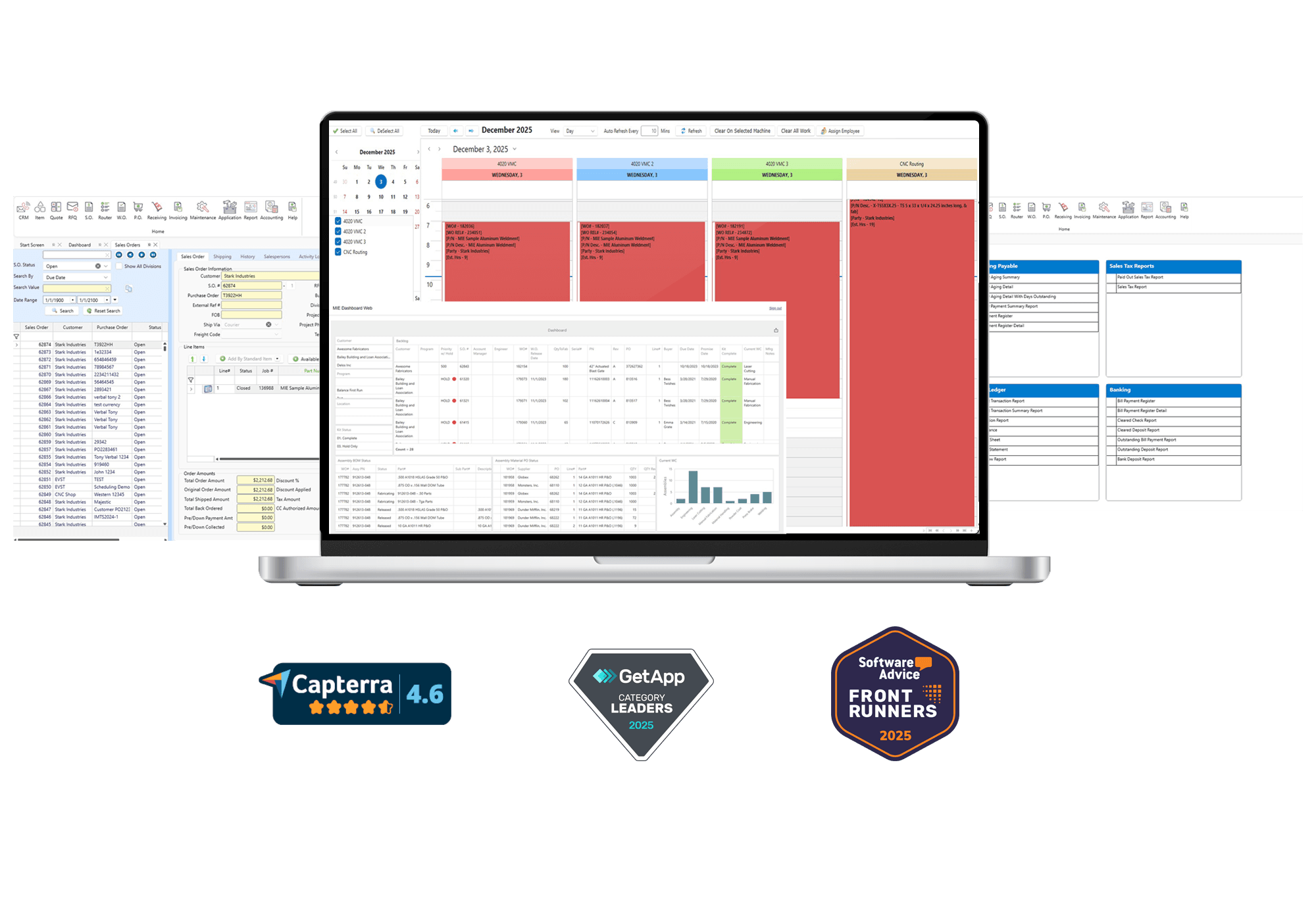


Save time and increase the accuracy of estimating with MIE Trak Pro’s quoting functionality which allows you to personalize formulas, track win/loss, and create quotes based on true costing data.
Learn more
Schedule production quickly and accurately with forward finite, backward infinite, and calendar-based drag-and-drop scheduling. Take the guesswork out of scheduling employees and machines to jobs.
Learn more
Gain insights into your production environment with MIE Trak Pro’s Work Order module. See all the information you want related to production in real-time.
Learn more
Take your quote and create a Sales Order in just a few clicks. Sales Orders can be created from an RFQ, Quote, PDF, EDI, and more—depending on your team’s workflow.
Learn more
Track your inventory and the information that matters to you, including lot number serialization, locations, remnants, WIP, non-netted, consignment, and more.
Learn more
Drive intelligent business decisions by using any of MIE Trak Pro’s standard reports or create personalized queries to get answers to the questions most important to you.
Learn moreOutcome: Faster quotes. Higher win rate. Protected margins.
How MIE helps: Standardizes estimating and connects quote data to actual job costs to tighten pricing over time.

Outcome: Better on-time delivery. Fewer expedites. Less firefighting.
How MIE helps: Schedules by real capacity and live job status so you can re-plan quickly without losing control.

Outcome: Earlier corrections. Better decisions. Stronger gross margin.
How MIE helps: Captures labor and material in real time and flags quote-vs-actual variance by operation.

We were amazed at how MIE Trak Pro could integrate with daily operations. (MIE Trak Pro) is software that works for the company and not the other way around.
Frank Roth EliteTool LLC
Some of the main benefits we are getting from MIE Trak Pro include job tracking and costing, time clock for payroll, and transparency in quoting.
Nick Watson CPT Engineering
We selected MIE Trak Pro over a very well-known ERP competitor because, after speaking with a salesperson, ownership stated, ‘these guys understand what we do.’ Since then, we’ve continued growing and working with the MIE team who don’t nickel and dime us for every little thing.
Andrea Fishback Consolidated Machine and Welding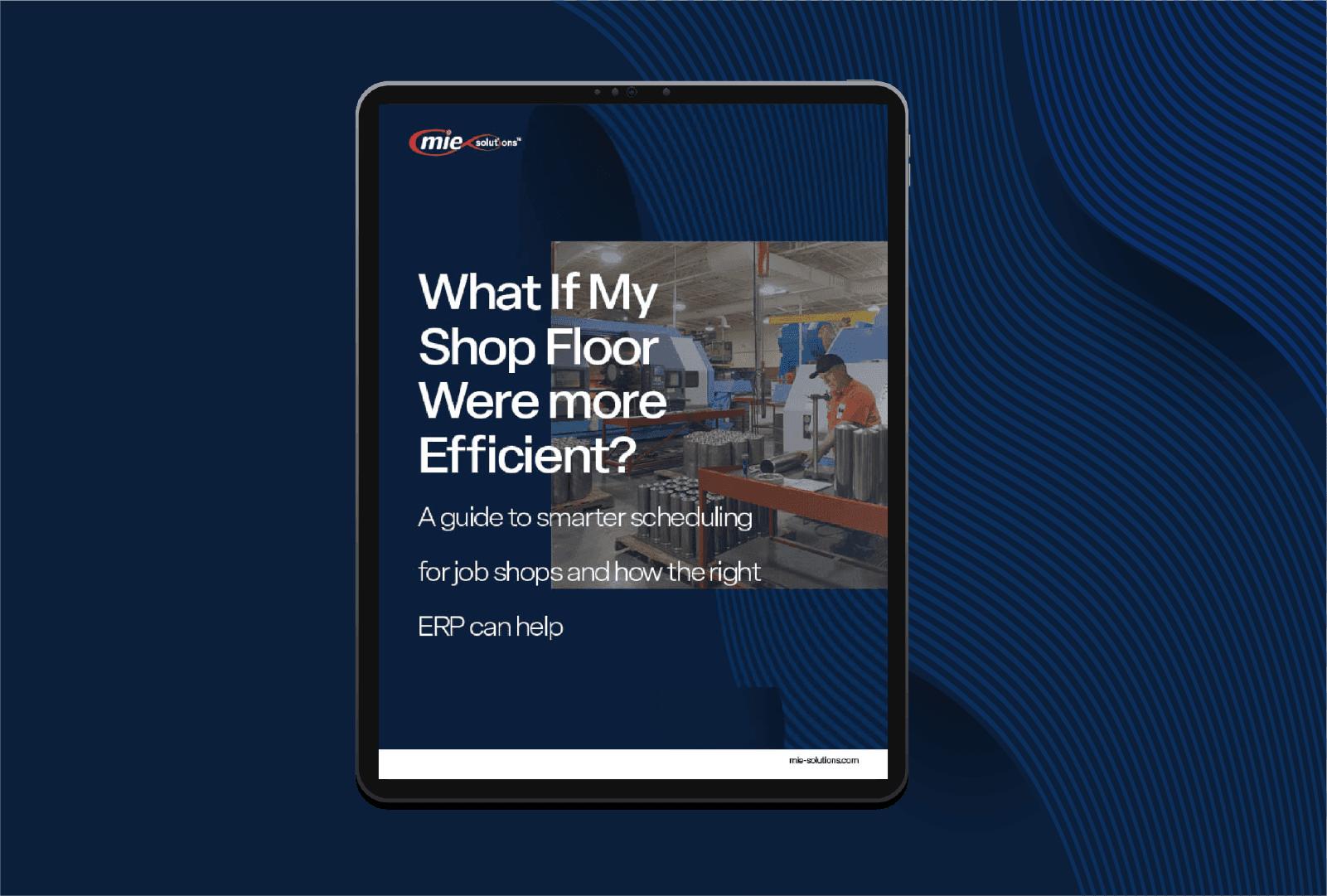
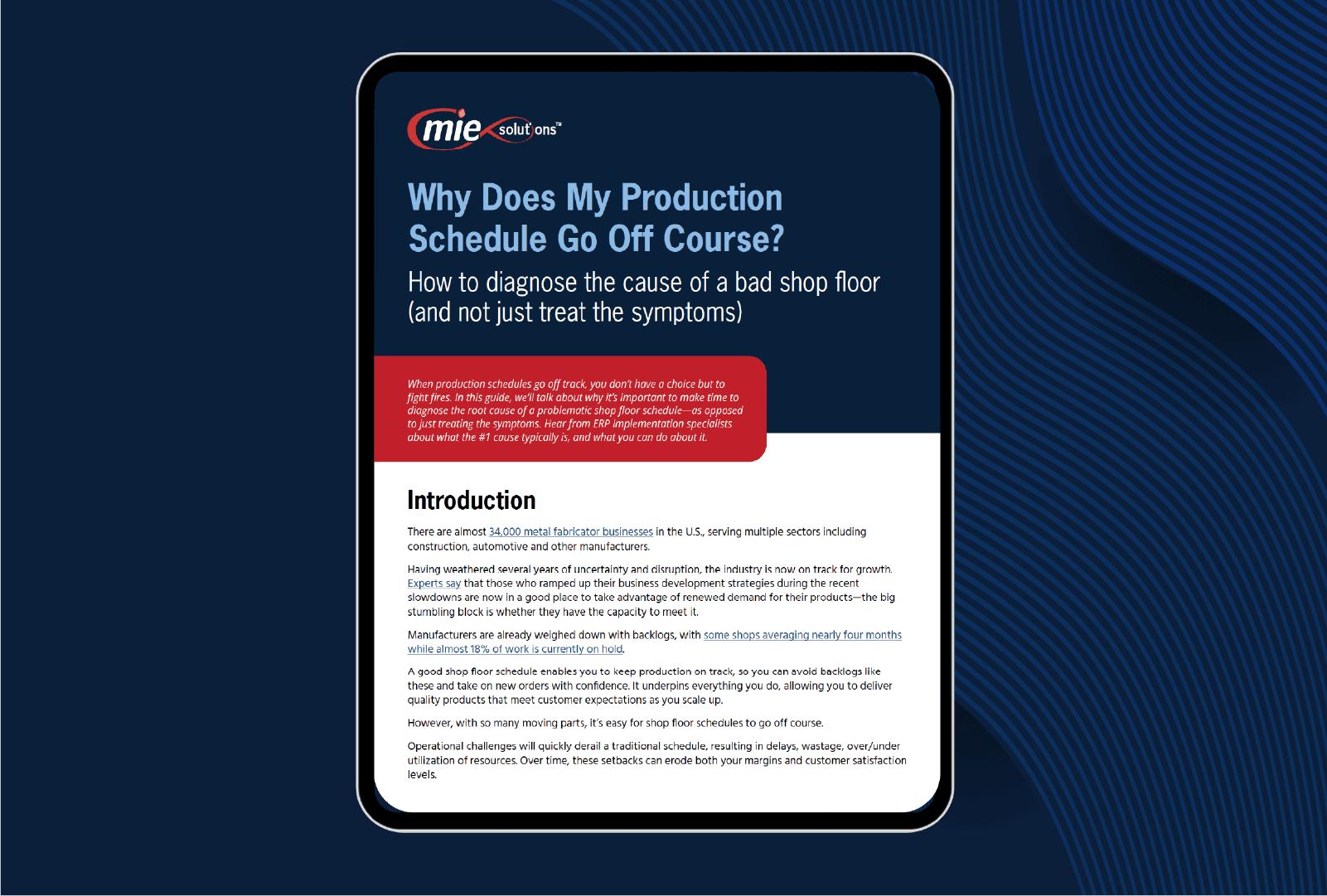


Skip the generic demos. Book a 1-on-1 session to see exactly how MIE Trak Pro handles your unique challenges.

See just how powerful MIE Trak Pro is by going on a software tour with one of our experts. We’d be happy to show you around, answer your questions, and most importantly, make sure MIE Trak Pro is the best fit for your business.
Running a modern machine shop without dedicated ERP software is like trying to machine precision parts without proper tooling—you might get by temporarily, but you’ll never achieve optimal results. For machining and tooling operations managing dozens of concurrent jobs across multiple CNC machines, the complexity quickly becomes overwhelming.
Small to medium-sized job shops face unique challenges that generic business software simply can’t address. When you’re juggling custom quotes, managing tool inventory across five different machining centers, tracking job progress through multiple operations, and ensuring quality compliance for aerospace or medical components, spreadsheets and disconnected systems create more problems than they solve.
The reality for most machine shops: Production managers spend hours each week manually updating schedules, machinists waste valuable time searching for tools or job information, and shop owners struggle to provide accurate delivery commitments to customers. This operational chaos doesn’t just hurt efficiency—it directly impacts your bottom line and your ability to compete for new business.
Modern ERP for machine shops eliminates this chaos by providing a unified system that connects every aspect of your operation. From the moment a customer requests a quote to the final shipment of precision parts, integrated software gives you the visibility and control needed to run a profitable, scalable machining operation.
Consider a typical scenario in a 10-machine job shop: You have 30 active jobs in various stages of completion, each requiring specific tooling, different materials, unique quality requirements, and distinct delivery deadlines. Your production manager needs to schedule new work while accounting for existing commitments, tool availability, machine capacity, and operator skills.
Without ERP for machine shops, this becomes a daily exercise in frustration. Your team relies on a patchwork of spreadsheets, paper travelers, whiteboards, and tribal knowledge. When a customer calls asking about their order status, someone has to physically walk the shop floor to find answers. When a rush order arrives, rescheduling existing work becomes a time-consuming puzzle with potential for costly errors.
The manufacturing labor shortage intensifies these challenges. With 2.1 million unfilled skilled jobs potentially costing the industry $1 trillion in lost revenue by 2030, every hour your team spends on administrative tasks instead of productive machining directly affects your profitability and growth potential.
Traditional manufacturing operations experience up to 30% production inefficiencies due to poor visibility, manual processes, and disconnected systems. For a machine shop generating $3 million annually, this inefficiency represents nearly $900,000 in lost revenue opportunity—enough to fund multiple new CNC machines or significantly expand your workforce.
These inefficiencies manifest in multiple ways:
ERP software designed specifically for machine shops addresses the unique workflows of job shop manufacturing. Unlike generic business software that forces you to adapt your proven processes, specialized manufacturing ERP adapts to how you actually run your shop.
Real-time job tracking gives everyone in your organization instant access to current job status. When your customer service team receives an inquiry about order status, they can provide accurate information immediately—no shop floor walks required. When your production manager needs to evaluate capacity for a new quote, the system shows exactly what resources are available and when.
MIE Trak Pro’s shop floor kiosk module integrates directly into your workflow, allowing operators to update job progress in real-time as they complete operations. This eliminates the delays and errors inherent in manual data entry while giving management continuous visibility into shop floor performance.
Forward finite scheduling ensures you never overcommit your resources. The system considers actual machine capacity, current workload, tool availability, and operator skills when calculating realistic delivery dates. This data-driven approach prevents the common scenario where optimistic promises lead to disappointed customers and stressed production teams.
Backward infinite scheduling works from customer delivery dates to create detailed production plans that account for all required operations, setup times, and potential bottlenecks. The calendar-based drag-and-drop interface makes it easy to adjust schedules when rush orders arrive or when equipment issues require rescheduling.
Smart tool management directly impacts your shop’s productivity and cost structure. ERP systems track tool locations, monitor usage patterns, and predict replacement needs before tools reach critical wear limits. Lot number serialization and location tracking ensure you always know what inventory you have, where it’s located, and when you need to reorder.
For custom machining projects requiring specialized tooling, remnant management capabilities help you maximize material utilization and reduce waste. The system tracks partial stock, automatically suggests using existing remnants for new jobs, and provides real-time visibility into work-in-progress inventory across all active jobs.
Speed and accuracy in quoting directly affect your win rate for new business. Modern ERP for machine shops integrates real-time material costs, current labor rates, and historical job data to generate competitive quotes quickly.
Instead of spending hours manually calculating costs and lead times, your estimators access accurate information instantly. The system pulls current material pricing, considers your actual shop capacity, and uses historical data from similar jobs to create realistic estimates. This data-driven approach helps you quote competitively while protecting your margins.
RFQ management functionality tracks quote requests from initial inquiry through final order, ensuring no opportunities fall through the cracks. When customers accept quotes, the system automatically converts them to production orders with all specifications, tolerances, and requirements already documented.
For machine shops serving regulated industries like aerospace and medical devices, documentation and traceability aren’t optional—they’re mandatory. Built-in quality management systems ensure that quality checks happen at the right points in your process, triggered by job progress rather than relying on manual oversight.
Corrective and preventive action tracking helps you identify quality issues early and implement systematic improvements. When non-conformances occur, the system guides you through root cause analysis, corrective actions, and verification processes. RMA processing and non-conformance tracking provide complete visibility into quality metrics, helping you continuously improve while meeting customer and regulatory requirements.
Understanding your shop’s performance requires access to accurate, timely data. Manufacturing ERP provides real-time analytics that help you identify trends, spot inefficiencies, and make informed decisions about resource allocation and capacity planning.
Custom report creation empowers your team to access the specific information they need without waiting for IT support. Whether you need detailed cost analysis for a specific customer, machine utilization reports for capacity planning, or quality metrics for certification audits, the system provides the data in formats you can immediately use.
Personalized queries and standard report templates give different team members access to role-appropriate information. Your production manager sees scheduling and capacity data, your quality manager accesses compliance reports, and your financial team reviews cost and profitability metrics—all from the same integrated system.
The Challenge: Standard Change-Makers needed an ERP system flexible enough to support their unique processes and customer requirements while providing the structure necessary for efficient operations. Generic software solutions forced them to choose between maintaining their proven workflows and gaining operational efficiency.
The MIE Trak Pro Solution: The platform’s customization capabilities allowed Standard Change-Makers to modify the system to match their specific needs rather than forcing process changes. This flexibility extended to custom fields, tailored workflows, and adaptable reporting that aligned with how they actually serve customers.
The Results: Robert Unterborn from Standard Change-Makers explains the impact: “MIE Trak Pro allows us to modify the system to meet our needs. With their partnership, we can continue showing our customers and prospects the ‘Standard Difference.’”
This customization capability became a competitive differentiator. When customers have unique requirements or need specific documentation formats, Standard Change-Makers can adapt their system to deliver exactly what’s needed—turning software flexibility into customer service excellence.
The Challenge: Litus Global Solutions needed to provide detailed documentation and traceability that met demanding customer requirements. Their previous systems couldn’t generate the comprehensive reports and records that sophisticated customers expected, creating administrative burden and limiting their ability to compete for high-value contracts.
The MIE Trak Pro Solution: Integrated reporting and BOM management capabilities gave Litus Global Solutions the ability to generate detailed, professional documentation for every job. The system automatically captures the data needed for comprehensive reports, eliminating manual record-keeping while ensuring accuracy.
The Results: “Greatly improved transparency. We are even asked by our customers to share reports, BOMs, and records because our documentation is far superior to their systems’ capability,” says Robert Kirkpatrick from Litus Global Solutions.
When your documentation quality exceeds your customers’ internal capabilities, you’ve transformed a compliance requirement into a value-added service. This level of professional documentation strengthens customer relationships and opens doors to more sophisticated contracts.
The Challenge: Upside Innovations lacked comprehensive visibility into their operations. Production teams couldn’t accurately predict product availability, supervisors struggled to evaluate individual employee performance, and management lacked the real-time data needed for strategic decision-making.
The MIE Trak Pro Solution: End-to-end visibility across all operations gave every team member access to the information they needed for their specific roles. Real-time updates ensured that scheduling information, inventory levels, and job progress reflected current reality rather than outdated snapshots.
The Results: Kevin Sharp from Upside Innovations highlights the transformation: “The overall visibility that we have of our business has improved a ton. Whether it is our operations team being able to quickly tell us when products will be available to ship or supervisors knowing exactly how efficient individual employees are performing.”
This comprehensive visibility enables proactive management rather than reactive firefighting. When you can see problems developing before they impact customers, you can address root causes instead of just managing symptoms.
The Challenge: Running a complete manufacturing operation across multiple disconnected software systems created inefficiency, data inconsistencies, and support headaches. Integration issues meant valuable time was spent reconciling data rather than focusing on production and customer service.
The MIE Trak Pro Solution: A single integrated platform replaced the patchwork of disconnected systems, providing unified data and streamlined workflows across all operations. Comprehensive support ensured successful implementation and ongoing optimization.
The Results: “We are now able to run the entire plant on a single piece of software. MIE Trak Pro came with much better support than we had previously,” reports James R. from Diamond Eye Performance.
Operating on a single integrated system eliminates the data synchronization issues and workflow gaps that plague shops using multiple disconnected tools. When every department works from the same accurate, real-time information, coordination becomes seamless and errors disappear.
ERP (Enterprise Resource Planning) for CNC machining is specialized software that integrates every aspect of job shop operations into one unified system. Unlike generic business software, ERP designed for machine shops understands the unique challenges of managing multiple concurrent jobs, complex tooling requirements, and demanding quality standards.
Machine shops need ERP because traditional methods—spreadsheets, paper travelers, and manual tracking—can’t provide the real-time visibility and coordination required for efficient operations. When you’re running 20-50 concurrent jobs across multiple CNC machines, each with different tooling, materials, and delivery requirements, you need automated systems to maintain control and profitability.
The platform connects quoting, scheduling, inventory management, shop floor control, quality management, and financial operations. This integration eliminates the data gaps and communication delays that create inefficiency in traditional operations.
Modern ERP systems reduce CNC machinery downtime through multiple integrated mechanisms that shift operations from reactive to proactive:
Preventive Maintenance Scheduling: The system tracks machine usage hours and automatically schedules maintenance before problems occur. Instead of dealing with unexpected breakdowns during critical jobs, you perform planned maintenance during scheduled downtime, keeping your equipment running when you need it most.
Tool Life Management: By monitoring cutting tool usage and wear patterns, ERP alerts operators before tools reach critical wear limits. This prevents the costly consequences of tool failure—scrapped parts, damaged machines, and missed delivery deadlines. Customers using comprehensive tool management typically reduce tool-related downtime by 30-35%.
Capacity-Based Scheduling: Understanding your actual machine capacity prevents overloading equipment, which is a common cause of premature wear and unexpected failures. The system schedules work based on realistic capacity, ensuring machines operate efficiently without excessive stress.
Job shops gain multiple operational and financial benefits from specialized ERP software:
Improved Efficiency: Automation can reduce production inefficiencies by up to 30%, directly impacting profitability. This improvement comes from better resource allocation, reduced setup times, and elimination of bottlenecks that slow production.
Enhanced Quality Control: Automated quality checkpoints ensure inspections happen at the right time based on job progress and customer requirements. This proactive approach prevents quality issues from reaching customers while providing the documentation needed for regulated industries.
Better Customer Service: Real-time visibility means you can provide accurate order status information immediately. When customers ask about their jobs, you give them precise answers rather than promising to “check and get back to them.”
Cost Reduction: The potential for 20% reduction in waste and production costs through automation helps job shops protect margins while remaining competitive on pricing.
Scalability: As your shop grows, ERP systems scale with you. The same software that manages 20 concurrent jobs efficiently handles 50 or 100 jobs without requiring complete system overhauls.
Selecting ERP software requires evaluating both technical capabilities and business fit:
Industry Specialization: Choose software built specifically for machine shops rather than adapting generic manufacturing software. Systems designed for job shop workflows understand your unique requirements for managing custom jobs, complex tooling, and variable production volumes.
Customization Capability: Your shop likely has unique processes that provide competitive advantages. Look for ERP platforms that adapt to your proven workflows rather than forcing you to change successful methods.
Integration Options: Ensure the system integrates with your existing equipment and tools. API connectivity and support for various data formats enable seamless integration with CNC machines, measurement systems, and other shop floor equipment.
Support Quality: Implementation and ongoing support significantly impact your success. Evaluate vendors based on their manufacturing expertise, implementation methodology, and long-term support commitment.
Scalability: Choose a system that grows with your business. The right ERP should handle your current volume while accommodating future expansion without requiring replacement.
Most machine shops see measurable return on investment within 6-12 months, with the exact timeline depending on several factors:
Quick Wins typically appear within the first 2-3 months as you eliminate obvious inefficiencies. Improved scheduling reduces overtime costs, better inventory management decreases emergency material purchases, and enhanced quality control reduces scrap and rework.
Operational Improvements compound over 6-9 months as your team becomes proficient with the system. Faster quoting leads to higher win rates, better capacity planning improves on-time delivery, and comprehensive reporting reveals optimization opportunities you couldn’t previously identify.
Strategic Benefits emerge after 12 months as you leverage accumulated data for strategic decisions. Historical job data improves estimating accuracy, trend analysis identifies profitable customer segments, and performance metrics guide equipment and workforce investments.
The 20% potential reduction in waste and production costs through automation often pays for the software investment within the first year, with continuing benefits as you optimize operations based on system insights.
Modern ERP systems are designed to work with your current shop floor equipment through multiple integration approaches:
API Connectivity: Open APIs allow bidirectional communication between your ERP and CNC machines. Job information flows from the ERP to machine controllers, while production data and machine status flow back to the system for real-time tracking.
Shop Floor Terminals: Dedicated kiosk modules at each work center let operators update job progress, record actual times, and access current job information without leaving the shop floor. This approach works with any equipment regardless of connectivity capabilities.
Data Import/Export: For equipment without direct connectivity, the system supports various data formats for importing CAD files, exporting job specifications, and synchronizing information with other shop floor systems.
The key is choosing ERP software with flexible integration options that accommodate both modern connected equipment and older machines that remain productive parts of your operation.
Successful ERP implementation follows a structured approach that minimizes disruption while accelerating time to value:
Phase 1: Foundation (Weeks 1-4): Start with core modules that provide immediate benefits—quoting, order entry, and basic job tracking. This establishes the system foundation while giving your team early wins that build confidence and momentum.
Phase 2: Shop Floor Integration (Weeks 5-8): Expand to production scheduling and shop floor control. As operators become comfortable with job tracking terminals, you gain real-time visibility into shop floor operations that drives better decision-making.
Phase 3: Advanced Capabilities (Weeks 9-12): Add quality management, advanced inventory control, and comprehensive reporting. With core operations running smoothly, you can focus on optimization features that provide competitive advantages.
Phase 4: Optimization (Ongoing): Continuously refine workflows, develop custom reports, and leverage accumulated data for strategic insights. The most successful implementations view ERP as an evolving platform rather than a one-time project.
Technology implementation succeeds or fails based on user adoption. Follow these proven practices:
Involve Key Users Early: Include shop floor operators, production managers, and quality personnel in system configuration decisions. When users help shape how the system works, they become advocates rather than resistors.
Provide Comprehensive Training: Invest in role-specific training that teaches users not just how to use the software, but why specific processes matter. Understanding the “why” behind procedures improves compliance and reduces errors.
Start with Champions: Identify respected team members who embrace new technology and train them first. These champions become peer resources who can answer questions and demonstrate best practices.
Celebrate Milestones: Recognize achievements throughout implementation—first successful quote, first job completed using the new system, first month of complete shop floor tracking. These celebrations maintain momentum and reinforce positive change.
Generic business software requires extensive customization to handle job shop manufacturing workflows. You end up paying for features you don’t need while still lacking capabilities critical for machining operations.
Manufacturing-specific ERP is built by people who understand job shops. Features like tool management, job routing, and operation-level tracking aren’t afterthoughts—they’re core capabilities designed based on real manufacturing requirements.
The result: implementations complete faster, user adoption improves, and you achieve operational benefits sooner because the software already speaks your language and understands your workflows.
Cloud-based ERP (like JobBOSS²) provides advantages for machine shops with limited IT resources:
On-premise solutions might be preferable for shops with:
The right choice depends on your specific situation, IT capabilities, and business requirements. Many modern platforms offer both options, letting you choose based on what works best for your operation.
Ready to eliminate the inefficiency, reduce the chaos, and gain the visibility needed to scale your machining operation? MIE Trak Pro provides the specialized ERP capabilities that machine shops need to compete and win in today’s demanding market.
Discover how MIE Trak Pro can transform your operation:
Our team understands machine shops because we’ve spent decades serving this industry. We know your challenges, speak your language, and provide solutions that work in the real world of job shop manufacturing.
Schedule your personalized demonstration today and see exactly how MIE Trak Pro addresses your specific operational challenges. No generic sales pitch—just a focused conversation about your shop, your goals, and how the right ERP platform can help you achieve them.
