Key Takeaways
Choose production scheduling software by matching your shop’s complexity, integration needs, budget, and implementation capacity—not feature lists alone.
- Replace manual scheduling to save time and reduce disruption; unplanned downtime costs U.S. manufacturers about $50 billion annually.
- Choose integrated ERP schedulers like MIE Trak Pro or MRPeasy for small-to-mid-sized shops needing affordable planning, inventory, quoting, and production control.
- Use finite-capacity APS tools such as EDGEBIC, JobPack, or PlanetTogether when bottlenecks, changeovers, labor, materials, and machine constraints drive delivery performance.
- Reserve enterprise platforms—Siemens Opcenter, DELMIA Ortems, and Infor—for complex multi-site operations prepared for higher costs and 6–18-month implementations.
- Evaluate AI-driven options like SkyPlanner and Plataine for real-time rescheduling, but ensure reliable shop-floor data and compatible integrations first.
- Test demos and calculate total cost of ownership, including integrations, training, infrastructure, and rollout time, before committing to a platform. Unplanned downtime costs U.S. manufacturers roughly $50 billion each year, and production scheduling software helps close the costly gap between planned output and shop-floor reality. We tested platforms ranging from finite-capacity APS tools to AI-driven schedulers because each solution takes a different approach to production planning. In fact, 96% of companies that move from manual processes to software-driven scheduling report time savings. This piece compares the 12 best production scheduling software platforms for manufacturing and assesses their scheduling capabilities, trade-offs, integrations, and total cost of ownership.
Production Scheduling Software Comparison Table
| Platform | Best Fit For | Key Scheduling Capabilities | Notable Strengths | Main Weaknesses | Integration Capabilities | Implementation Timeline | Pricing Model |
|---|---|---|---|---|---|---|---|
| 1. MIE Trak Pro | Job shops, metal fabricators, small businesses needing enterprise capability | Forward finite, backward infinite, whiteboard, cell scheduling; drag-and-drop Planning Board | 4.6/5 rating; flexible scheduling methods; integrated ERP system; responsive support (4.8/5) | SQL database can slow with large queries; shallow ECO process; customization requires SQL knowledge | Authorize.Net, Avalara, FedEx, UPS, QuickBooks, SolidWorks, Trumpf Boost, Paperless Parts | 4 months average; 19-month ROI | Custom pricing; minimum 5 users |
| 2. MRPeasy | Small manufacturers (10-200 employees) | Forward/backward scheduling, finite resource scheduling, multi-level manufacturing orders, drag-and-drop rescheduling | First small-business ERP that combines MPS with short-term scheduling; doubled capacity for users; strong BOM management (86.67% rated important) | Limited financial/accounting features; does not scale to multi-plant operations; minimal CRM; steep learning curve | BigCommerce, Magento, Power BI, QuickBooks Online, ShipStation, Shopify, WooCommerce, Xero, Zapier | 2 months median | $49-$149/user/month; $6,000-$25,000/year TCO |
| 3. EDGEBIC (Formerly RMDB) | Job shops, defense contractors, electronics makers, contract manufacturers | Finite capacity for machines, labor, materials, and tooling; drag-and-drop routing; Theory of Constraints; sequence-dependent setup | GE increased on-time shipping from 30% to 90%; 5-day implementation; CP-SAT optimizer with a proven optimality gap | Windows desktop only; no live ERP connectors; manual import-export required; not a full ERP | SAP, Epicor, NetSuite, Dynamics, QuickBooks, Sage, JobBOSS, Infor, Acumatica, Odoo, Fourth Shift, SYSPRO | 5 days on-site with training | $25,000 (APS) or $35,000 (Complete) one-time perpetual license |
| 4. JobPack | Job shops, make-to-order manufacturers in automotive, aerospace, medical, energy | Drag-and-drop finite-capacity scheduler; immediate machine monitoring through MTConnect/OPC UA; what-if scenarios | On-time delivery improved by up to 17%; 6-week implementation; 4.5/5 rating; native machine monitoring | Smaller vendor with limited support resources; data dictionary mainly in German; complex UI with 20+ options per screen | Bi-directional with 95% of ERPs, including Epicor, Plex, and Syspro; no custom development required | 3-10 weeks (8-10 weeks average) | Mid-range perpetual licensing |
| 5. Lillyworks Visual DBR | High-mix, low-volume job shops and Theory of Constraints practitioners | Drum-Buffer-Rope (DBR) scheduling; buffer-based prioritization; The Predictor simulation tool | Lead times cut from 6-8 weeks to 3-4 weeks; 90%+ on-time performance; $125K in cash freed through WIP reduction; results in 60-90 days | Niche DBR approach may not suit conventional schedulers; learning curve; occasional bugs; weak billing integration | Epicor, IQMS, SyteLine, M1, Salesforce, Sage, QuickBooks, Oracle, Infor, Plex, Acumatica | Results in 60-90 days | Mid-range perpetual; ~$300-$2,500/user; $35,000-$80,000+ first year |
| 6. PlanetTogether APS | Batch, discrete, process, and multi-site manufacturers in food/beverage, life sciences, chemicals, aerospace | Capacity planning, schedule optimization, bottleneck management, what-if scenarios; 50+ sequencing methods | Medical device maker cut inventory by 15% and overtime by 20% in 60 days; SOC 2 compliant; Azure cloud | Not standalone, as it requires an ERP; on-premise deployment needs SQL Server and Windows; standard rollout takes 4-6 months | SAP S/4HANA, Dynamics 365, NetSuite, Acumatica, Sage, Epicor, QAD, Infor, AVEVA MES (REST API) | 4-6 months standard; SureStart in 45 days | Custom quote based on ERP and integration complexity |
| 7. Siemens Opcenter APS | Large enterprises in automotive, food/beverage, tank farm operations | Express/Standard/Advanced tiers; heuristic and linear-programming optimization; 50,000-operation limit | IDC Leader 2025; delivery reliability improved from 60% to 95%; 75% lead-time reduction; 10/10 performance rating | No full web app; requires Windows and MS SQL Server; implementations take 6-18 months, or 24+ months for multi-plant MES | SAP (Opcenter Connect MOM), Oracle Fusion Cloud, Dynamics 365 through an open API gateway | 6-18 months standard; 24+ months multi-plant | $75,000-$500,000+; $150,000-$750,000 first year |
| 8. Asprova APS | Aerospace, automotive, electronics, pharmaceuticals, metalworking | Finite capacity for thousands of operations in seconds; sequential, parallel, converging, and branching processes | 52.4% Japan market share; 3,900+ customers globally; 4.9/5 rating; smooth implementation; reduced planning hours | Steep learning curve; high price compared with competitors | SAP, Oracle EBS, JD Edwards, Dynamics AX, QAD through TSV; any Windows system through ODBC | Not specified | Basic ¥15,000/user one-time; training and consultation separate |
| 9. DELMIA Ortems | Process manufacturers in food, beverage, pharmaceutical, chemical sectors | Virtual twin optimization; finite capacity for long-, mid-, and short-term planning; three tiers (Planner/Scheduler/Manufacturing) | Novares: 98.5% service level, 8-day inventory; Mitsubishi: 25% less planner time; 4.7/5 finite-capacity rating | Complex UI and resource customization; dated interface; multi-site governance overhead | SAP Adapter certified; VIC for any ERP/MES | 6-18 months | $100,000-$500,000+ first year |
| 10. Infor CloudSuite Industrial Scheduling | Discrete, process, and mixed-mode manufacturers in electronics, metal fabrication, medical devices, furniture | Dual-mode infinite/finite scheduling; hybrid approach for bottlenecks and flexible resources | 4.1/5 Gartner rating; embedded Birst analytics; Coleman AI for demand sensing and predictive maintenance | Steep learning curve; narrow QMS module; difficult upgrades; SaaS limits customization | MachineMetrics through Infor ION API Gateway; immediate work-order and labor synchronization | 9-18 months | $150-$400/user/month; $920K-$2.4M TCO (100 users, 3 years) |
| 11. Optessa | Automotive OEMs and high-mix manufacturers | Patented mathematical algorithms; Scenario/Capacity/Demand/Inventory/Annealing dashboards; AI-driven optimization | 4.8/5 across 795 ratings; 4 of the top 10 auto OEMs use it; “second to none” support | Bolted-on layer, not standalone; depends on an existing MES, ERP, or SCM | Works with any MES, ERP, SCM, or S&OP system; bi-directional data transfer | Not specified | Custom quote |
| 12. SkyPlanner APS | Discrete and process manufacturers in metal, electronics, plastics, food, pharmaceutical | Arcturus AI engine; immediate finite-capacity Gantt; browser-based shop-floor app | Piristeel: improved delivery reliability; Laboratory & Allied: 90% efficiency gain, 50% on-time reporting; 4.5/5 rating | Limited customization; compatibility gaps with inventory systems; underdocumented AI core; depends on shop-floor reporting | REST API with webhooks: SAP S/4HANA, Dynamics 365, Odoo, QuickBooks, MRPeasy, Unleashed, Google Sheets | Not specified | €199/month per workstation; 30-day free trial |
| 13. Plataine | Aerospace, composites, automotive, high-mix manufacturers | AI Agents with Practimum-Optimum algorithm; one-click complete planning; continuous optimization | 100% production visibility; 30% throughput increase; 15% faster on-time delivery; 40% rework reduction; 6-12 week go-live | Software gaps and unreliable hardware (3.0/5 workplace culture) | SAP S/4HANA, ERP, MES, PLM; formal SAP Manufacturing Execution OEM agreement | 6-12 weeks to go live; 3-6 months ROI | SaaS model; monthly payments scaled to users and computing needs |
1. MIE Trak Pro
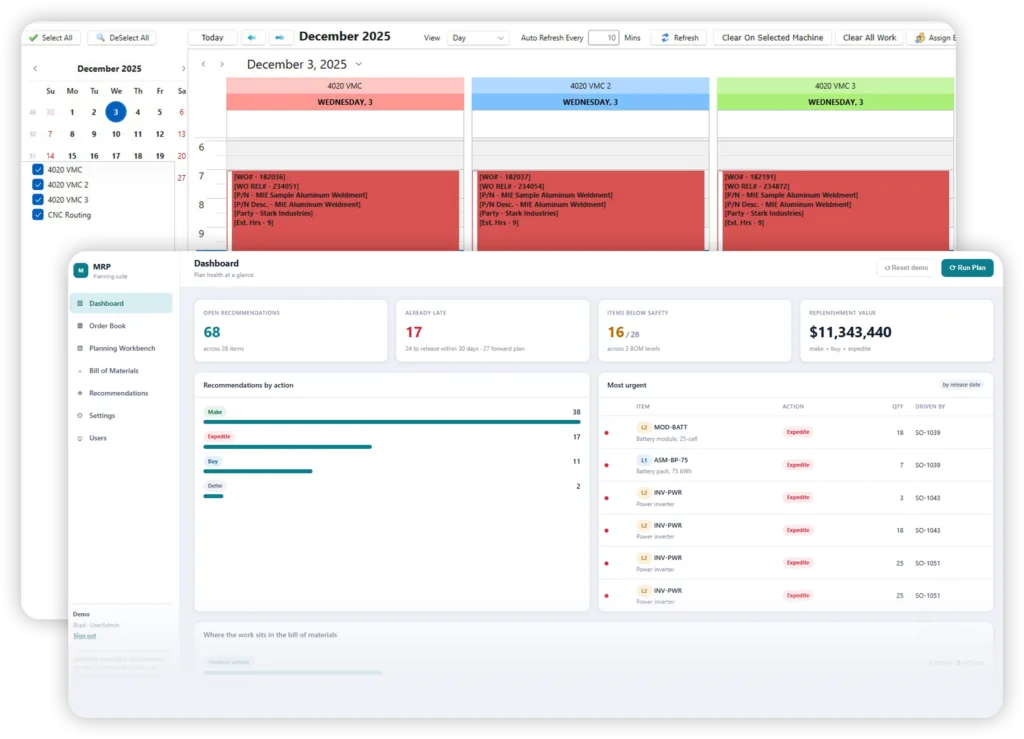
Image Source: MIE Solutions
MIE Trak Pro is a manufacturing ERP system from MIE Solutions. Its scheduling module sits at the platform’s core instead of serving as an add-on. The system brings quote and work order data into one place, so schedules use accurate costing data rather than estimates. It supports forward finite, backward infinite, whiteboard, and cell scheduling. Shops can choose the method that suits their floor layout instead of using one rigid approach for every job.
The scheduling engine uses backwards infinite techniques to identify optimal schedules. The Planning Board module lets users drag and drop schedules across machines and employees, and it refreshes throughout the day as priorities change. Job shops handling thousands of work orders can create complete schedules within minutes, which helps them manage frequent changes.
MIE Trak Pro suits job shops and metal fabricators that manage multiple machines and complex orders. It also works for small businesses that need enterprise-level capabilities without enterprise overhead. EVS Metals provides one example. This East Coast manufacturer has used MIE Trak Pro in several facilities since 1997 and credits the system for staying “simple enough yet complex enough” to track everything a shop needs.
Reviewers give MIE Trak Pro an overall rating of 4.6. Customer support scores 4.8, while value for money scores 4.6. Users value its flexibility and responsive support, along with the option to run quoting, manufacturing, inventory, and accounting in one connected system. Weaknesses include SQL database slowdowns during large queries. The ECO process may also lack enough depth for companies operating under strict revision control, and customization requires staff who understand SQL and report writing.
The platform integrates with many third-party tools, including:
- Payment and tax systems such as Authorize.Net, Avalara AvaTax, Paytrace, and Chase Paymentech
- Shipping services such as DHL, Easypost, FedEx ShipStation, and UPS WorldShip
- Manufacturing tools such as CADLink, MIE BOM Importer for SolidWorks files, TrueNest, and Trumpf Boost
- QuickBooks and Paperless Parts, which remove duplicate data entry between quoting and accounting
Pricing is custom, although per-user monthly costs start at about $500 under a subscription model with a five-user minimum. Implementation takes an average of four months. Return on investment typically arrives after about 19 months, and real user data shows average discounts of 7%.
2. MRPeasy

Image Source: MRPeasy
MRPeasy uses a cloud-first approach to production scheduling and is built for small manufacturers, not large enterprises with complex multi-plant operations.
MRPeasy scheduling capabilities and best-fit manufacturers
The Production Planning module manages manufacturing order scheduling, material and capacity planning, and resource assignments for parts, equipment, and workers. Click-and-drag rescheduling allows planners to update the shop floor calendar and Gantt charts as needed. The system supports forward and backward scheduling, multi-level manufacturing orders, and finite resource scheduling. BOMs and Routings feed directly into operation duration and cost calculations. MRPeasy was the first ERP/MRP system aimed at small businesses to combine long-term Master Production Schedule planning with short-term scheduling in one suite. This setup works well for manufacturers with 10 to 200 employees that need solid MRP functionality without the overhead of a full enterprise ERP.
MRPeasy strengths
Capterra data from 1,735 manufacturing reviews shows that buyers value Purchase Order Management, Production Management, and Traceability. MRPeasy performs well in these areas: 80.30% of 66 reviewers rated purchase order tracking as important or highly important, while 100% of 48 reviewers gave production management the same rating. Traceability was a priority for 91.23% of 57 reviewers. BOM management also performs well, with 86.67% of 90 reviewers rating it as important. Users also praise the system’s support for multi-level assemblies. Users report doubling capacity after adoption, tracking lots down to individual serial numbers, and experiencing near-zero downtime outside scheduled maintenance windows.
MRPeasy weaknesses and limitations
Financial and accounting features are intentionally limited, so most users continue to use QuickBooks or Xero with MRPeasy instead of relying on it as a general ledger. The platform is not designed for complex multi-plant operations. It also lacks field service management, and its CRM features are minimal. Some users report a steep learning curve for teams without experience using manufacturing software, although onboarding materials can ease the transition.
MRPeasy integrations and implementation requirements
MRPeasy integrates with BigCommerce, Magento, Microsoft Power BI, Pipedrive, QuickBooks Online, ShipStation, Shopify, WooCommerce, Xero, and Zapier. The Magento integration matches products by SKU with MRPeasy’s Part Number field. It imports only paid, unfulfilled orders created within the previous 30 days and can sync inventory levels to Magento every hour. WooCommerce orders import automatically. The system reserves available goods and creates demand for items that still require production or purchasing. Implementation is less demanding than with on-premise systems. Small manufacturers typically go live within two months, while initial training costs $1,000 to $2,500 per user. Annual training costs typically add 10 to 15% of the original investment. Consulting partners vary in price and delivery time. Altemir Consulting charges $12,000 to $25,000 over about three months, while Cohesis charges $9,750 to $13,000 over 3 to 4 months.
MRPeasy pricing and total cost of ownership
MRPeasy offers four pricing tiers: Starter at $49 per user per month, Professional at $69, Enterprise at $99, and Unlimited at $149. The plans require no contracts and include a 30-day free trial. The first ten users pay the full tier rate. Each additional block of ten users costs a flat $79 per month, regardless of tier, which helps growing teams control costs. Typical total cost of ownership ranges from $6,000 to $25,000 per year, with implementation costs between $0 and $8,000.
3. EDGEBIC (Formerly RMDB)

Image Source: usersolutions.com
EDGEBIC is production scheduling software from User Solutions. It uses the engine from Resource Manager DB (RMDB), a platform that GE, BAE Systems, Cummins, and the US Navy have used for decades.
EDGEBIC scheduling capabilities and best-fit manufacturers
The engine handles finite capacity scheduling across machines, labor, materials, and tooling at the same time. It also includes a drag-and-drop graphical routing designer and Theory of Constraints anchor scheduling based on a pinned bottleneck. Sequence-dependent setup matrices apply the actual changeover time instead of an average, while operator skills and certifications complete the constraint model. This setup suits job shops, defense contractors, electronics makers, and contract manufacturers with high-mix production.
EDGEBIC strengths
GE Railcar Services increased on-time shipping from 30% to more than 90% with this engine across its repair network. The USS Nimitz program level-loaded more than 26,000 preventive maintenance tasks over two years. Plastilite Corporation produced a complete schedule and completed full Fourth Shift ERP integration in five days. Homestead Furniture reduced weekly scheduling work from 40 hours to about 2. A built-in CP-SAT mathematical optimizer reports a proven optimality gap instead of a vague claim of improvement.
EDGEBIC weaknesses and limitations
EDGEBIC runs as a Windows desktop application rather than cloud software. It does not offer live ERP connectors and relies on Excel, CSV, or database import-export masks that planners must rerun after changes on the shop floor. EDGEBIC is not an ERP system. General ledger and purchasing functions require EDGEBIC Complete or a separate system.
EDGEBIC integrations and implementation requirements
Published guides cover SAP, Epicor, NetSuite, Dynamics, QuickBooks, Sage, JobBOSS, Infor, Acumatica, Odoo, Fourth Shift, SYSPRO, Global Shop Solutions, IQMS/DELMIAworks, and Made2Manage. Any ERP that exports Excel, CSV, or database tables also qualifies. Implementation follows a five-day on-site schedule and includes training. Plastilite’s five-day rollout reflects that timeline.
EDGEBIC pricing and total cost of ownership
User Solutions prices EDGEBIC APS at a one-time cost of $25,000. EDGEBIC Complete costs $35,000 one time and adds MRP, inventory, and purchasing. Both use perpetual licenses with no recurring fees. Payback takes 30 to 90 days. Homestead Furniture serves as the standard for a 50 to 80% reduction in scheduling labor.
4. JobPack

Image Source: JobPack
JobPack has a distinct background. Founded in 1992 and headquartered in Elgin, Illinois, the privately owned platform has grown to more than 1,100 installations across North America and Europe.
JobPack scheduling capabilities and best-fit manufacturers
The drag-and-drop Scheduler creates plans based on actual machine and labor capacity instead of assuming unlimited resources. It identifies bottlenecks and scheduling conflicts weeks before due dates, which lets planners run what-if scenarios to find a better path. Live machine monitoring uses native MTConnect and OPC UA protocols with modern CNC equipment. Legacy machines connect through hardware kits such as EH110 current sensors and digital I/O hardware. This mix of finite-capacity scheduling and clear Gantt chart visualization works best for job shops and make-to-order environments. JobPack’s client base includes automotive, aerospace, medical, and energy manufacturers.
JobPack strengths
Manufacturers using JobPack report on-time delivery improvements of up to 17%. Its six-week implementation timeline is shorter than enterprise competitors’ timelines, which often range from 6 to 12 months. Software Advice reviewers give JobPack an overall rating of 4.5. Customer support scores 4.6, functionality scores 4.4, and value for money scores 4.2.
JobPack weaknesses and limitations
Reviewers describe JobPack as a smaller vendor whose support resources fall behind those of larger competitors. One review cited a data dictionary that was mostly in German, with only a partial English translation, which made report creation harder. Another noted more than 20 clickable options on one screen, causing some users to rely only on essential functions.
JobPack integrations and implementation requirements
JobPack connects bi-directionally with more than 95% of customers’ ERP systems, including Epicor, Plex, and Syspro, without custom development. Implementation can take as little as 3 weeks, though the average timeline is 8 to 10 weeks. The process includes discovery, installation, and training.
JobPack pricing and total cost of ownership
JobPack uses mid-range perpetual licensing and offers reasonable pricing for small shops.
5. Lillyworks Visual DBR

Image Source: usersolutions.com
Lillyworks takes a different approach. It builds its scheduling engine around Theory of Constraints and Drum-Buffer-Rope (DBR) principles rather than finite-capacity sequencing. The company dates back to 1991, when founder Dick Lilly introduced VISUAL Manufacturing as the sector’s first graphical-interface scheduling tool. That approach later developed into the Dynamic Production Method that powers today’s Protected Flow Manufacturing platform.
Lillyworks Visual DBR scheduling capabilities and best-fit manufacturers
Each job moves through a Framework that combines a due date with a buffer based on the remaining work. A four-day job, for example, may include a ten-day cushion to account for material shortages or changing priorities. Buffer-remaining calculations continually reprioritize jobs already released into WIP. The Predictor, a simulation tool, evaluates hundreds of work orders at once and flags those at risk of running late. This bottleneck-focused method works well for high-mix, low-volume job shops and manufacturers that use Theory of Constraints. It may not suit companies that want rigid due-date sequencing.
Lillyworks Visual DBR strengths
Clients such as Graphicast and Mid-Continent Engineering report lead times falling from six to eight weeks to three to four weeks. On-time performance has increased beyond 90%. WIP release control can also free up cash. A shop holding $500,000 in WIP could free roughly $125,000 after reducing volumes by one-third. Most clients see results within 60 to 90 days after go-live. The SaaS model keeps data encrypted and available on any device.
Lillyworks Visual DBR weaknesses and limitations
Reviewers describe the DBR, constraint-driven approach as a niche option that may not fit manufacturers that prefer conventional scheduling methods. Users also report a learning curve when adapting to the prioritization method, minor bugs, and limited billing-system integration.
Lillyworks Visual DBR integrations and implementation requirements
Lillyworks connects directly with Epicor, IQMS, SyteLine, and M1. Its broader partner list includes Salesforce, Sage, QuickBooks, Oracle, Infor, Plex, and Acumatica. Through collaboration with ECI’s Macola ERP, Lillyworks brings work-order and material data directly into shop-floor priorities without replacing the existing ERP investment.
Lillyworks Visual DBR pricing and total cost of ownership
Lillyworks uses a perpetual-license model that sits in the mid-range tier among scheduling platforms. Independent estimates suggest monthly costs begin near $300 per user and can reach $2,500 for ten users. First-year costs, including onboarding, may range from $35,000 to $80,000 or more. Lillyworks does not offer a free trial or free tier.
6. PlanetTogether APS

Image Source: PlanetTogether APS
PlanetTogether APS, now part of AVEVA, differs from the bolt-on schedulers covered so far. It acts as a dedicated scheduling layer over manufacturers’ existing ERP and MES systems instead of requiring them to replace their systems of record.
PlanetTogether APS scheduling capabilities and best-fit manufacturers
The platform creates schedules using capacity, material, labor, routing, changeover, due-date, and inventory data from connected ERP and MES systems. Capacity Planning, Schedule Optimization, Bottleneck Management, What-If Scenario Planning, and Material Availability Planning work together. The engine identifies the most constrained resource and sequences work around it. It also uses more than 50 sequencing methods linked to KPIs such as profitability and customer priority. Batch, discrete, process, and multi-site manufacturers use the system in food and beverage, life sciences, chemicals, aerospace, and metal fabrication. Customers include AFL, Saint-Gobain, Caterpillar, and Graphic Packaging.
PlanetTogether APS strengths
A medical device manufacturer removed 250 forecast-based production orders, reduced inventory overhead by about 15%, and cut overtime labor costs by roughly 20% within 60 days of going live. A snack manufacturer improved sequencing and reduced changeover time. An automotive manufacturer replaced manual planning with up-to-the-minute scheduling. The system operates on Azure Data Cloud and provides SOC 2 compliance with encryption in transit and at rest.
PlanetTogether APS weaknesses and limitations
PlanetTogether cannot operate as a standalone system. It relies on the ERP system to manage orders, inventory, and financial data. On-premise deployments require Microsoft SQL Server and Windows, which create more infrastructure overhead than pure cloud tools. Standard rollouts that include full blueprinting, configuration, and hypercare support typically take 4-6 months.
PlanetTogether APS integrations and implementation requirements
Bi-directional REST API connectivity connects PlanetTogether with SAP S/4HANA, Microsoft Dynamics 365, Oracle NetSuite, Acumatica, Sage, Epicor, QAD, and Infor. The platform also integrates with AVEVA MES, Kinaxis Maestro, John Galt, Blue Ridge, and Shiftboard. Most integrations take 4-8 weeks, depending on data quality and field mapping. The SureStart rollout path supports a defined scheduling workflow in about 45 days.
PlanetTogether APS pricing and total cost of ownership
PlanetTogether does not publish fixed pricing tiers. Manufacturers must request a demo or APS readiness review to receive a quote based on their ERP environment, integration complexity, and site count.
7. Siemens Opcenter APS

Image Source: Siemens Digital Industries Software Blogs
Siemens Opcenter APS originated with Preactor, a UK scheduling company that Siemens acquired in 2013. It now serves as part of the Opcenter manufacturing operations management portfolio at ISA-95 Level 3, between shop-floor automation and ERP.
Siemens Opcenter APS scheduling capabilities and best-fit manufacturers
The platform comes in Express, Standard, and Advanced tiers. These options range from simple forward and backward scheduling to heuristic and linear-programming optimization for thousands of operations and hundreds of resources. IDC named Siemens a Leader in its 2025 APS MarketScape and highlighted more than 30 years of finite-capacity scheduling expertise, along with AI-driven capabilities such as genetic algorithms and Monte Carlo tree search. Opcenter APS 2510 increased the maximum links and operations limit to 50,000 and improved data-loading performance by up to 75%. The platform is best suited to large enterprises in automotive and food and beverage manufacturing, as well as tank farm operations.
Siemens Opcenter APS strengths
One documented plant increased delivery reliability from 60% to 95% and reduced lead time by 75% after integrating Opcenter APS with its technology stack. Softwareconnect reviewers give the platform 10/10 for performance and core features, with the same 10/10 score for value.
Siemens Opcenter APS weaknesses and limitations
The platform still lacks a fully web-based application, and deployment requires Windows and MS SQL Server. Standard implementations take 6 to 18 months, while multi-plant MES rollouts can exceed 24 months.
Siemens Opcenter APS integrations and implementation requirements
Opcenter Connect MOM provides prebuilt, bi-directional links with SAP to release orders, exchange BOMs, and process confirmations. Oracle Fusion Cloud and Microsoft Dynamics 365 connect through an open API gateway.
Siemens Opcenter APS pricing and total cost of ownership
Siemens provides pricing by quote. Industry data places Standard licensing between $75,000 and $150,000, while Advanced licensing ranges from $150,000 to more than $500,000. Typical first-year costs therefore range from $150,000 to $750,000.
8. Asprova APS

Image Source: www.asprova.com
Asprova APS is a private company founded in Tokyo in 1994. It has 11 to 50 employees and supports more than 2,900 manufacturing sites worldwide.
Asprova APS scheduling capabilities and best-fit manufacturers
The engine creates finite-capacity schedules for thousands of operations in seconds. It handles sequential, parallel, converging, and branching processes across supply-chain, inventory, and purchasing activities in one pass. Asprova holds a 52.4% market share in Japan and serves more than 3,900 customers worldwide. Its customers work in aerospace, automotive, electronics, pharmaceuticals, and metalworking, with more than 1,000 users in eighteen countries.
Asprova APS strengths
Gartner reviewers highlight smooth implementation and strong support during the serial phase. Software Advice users give the platform a 4.9 rating based on nine reviews, citing easy ERP integration and fewer planning hours.
Asprova APS weaknesses and limitations
Reviewers report a steep learning curve at the start and note that the price exceeds that of lighter competing tools. They also describe it as the most complete option available.
Asprova APS integrations and implementation requirements
Asprova offers bidirectional interfaces with SAP, Oracle EBS, JD Edwards, Dynamics AX, and QAD through TSV file exchanges. It also connects with any Windows-compatible system through open ODBC connections.
Asprova APS pricing and total cost of ownership
Software Advice lists a one-time Basic plan fee of ¥15,000 per user. Official guidance directs buyers to distributor quotes, with training, consultation, and system integration priced separately.
9. DELMIA Ortems

Image Source: Andea
Dassault Systèmes owns DELMIA Ortems today. The platform began in 1997 as a French APS specialist before Dassault Systèmes acquired it in 2014 and added it to the DELMIA portfolio.
DELMIA Ortems scheduling capabilities and best-fit manufacturers
A configurable optimization engine creates a virtual twin of machines, materials, workforce, and processes. It applies finite-capacity scheduling from long-term planning through short-term execution. Its three tiers, Production Planner, Production Scheduler, and Manufacturing Planner, range from simple capacity visualization to multi-site supply chain synchronization. Food, beverage, pharmaceutical, and chemical manufacturers benefit most because of its support for batch sequencing and cleaning constraints.
DELMIA Ortems strengths
Novares standardized planning across 18 plants, achieved a 98.5% customer service level across the group, and reduced inventory to eight days. Mitsubishi Chemical Performance Polymers went live in less than 10 months and saved planners about 25% of their time each day. Gartner reviewers rate the finite-capacity engine at 4.7 and ERP/MES integration depth at 4.6.
DELMIA Ortems weaknesses and limitations
Users may find it difficult to customize the user interface and configure resource-availability constraints. The UI looks dated compared with newer SaaS APS tools, and multi-site deployments can increase governance overhead.
DELMIA Ortems integrations and implementation requirements
A certified SAP Adapter provides a direct connection, while VIC exchanges data with other ERP or MES systems. Implementation typically takes 6 to 18 months.
DELMIA Ortems pricing and total cost of ownership
First-year costs commonly range from $100,000 to more than $500,000 for software and implementation, plus maintenance.
9. Infor CloudSuite Industrial Scheduling

Image Source: www.infor.com
Infor CloudSuite Industrial Scheduling, built on the SyteLine ERP core, turns production planning into a dual-mode engine instead of relying on one rigid approach.
Infor CloudSuite Industrial Scheduling capabilities and best-fit manufacturers
The system supports both infinite and finite scheduling, and most shops use a mix of both. Finite scheduling reserves bottleneck resources based on actual capacity, while infinite scheduling uses available machine time for flexible, operator-led sequencing. This hybrid approach suits discrete, process, and mixed-mode manufacturers, including electronics, metal fabrication, medical device, and furniture companies.
Infor CloudSuite Industrial Scheduling strengths
Gartner reviewers give the platform a 4.1 out of 5 rating and point to its manufacturing depth and integrated quality management. G2 users give it an average score of 3.9 and highlight its production planning tools and inventory accuracy. Embedded Birst analytics and Coleman AI provide demand sensing and predictive maintenance alerts.
Infor CloudSuite Industrial Scheduling weaknesses and limitations
Reviewers cite a steep learning curve, a limited QMS module, and challenging upgrade cycles. SaaS multi-tenancy also limits some customization options that on-premise SyteLine previously supported.
Infor CloudSuite Industrial Scheduling integrations and implementation requirements
MachineMetrics connects in both directions through the Infor ION API Gateway and syncs work orders and labor tickets in real time. Implementation usually takes 9 to 18 months.
Infor CloudSuite Industrial Scheduling pricing and total cost of ownership
Monthly per-user costs range from $150 to $400. Implementation costs range from $200,000 to $1,000,000, while the three-year TCO for 100 users can reach $920,000 to $2.4 million.
10. Optessa

Image Source: Demystifying PLM
Optessa entered the scheduling market in 2001. Its name comes from Optimization in Sequencing and Scheduling Applications. Eyelit Technologies acquired the company in February 2024 and added it to its smart manufacturing portfolio.
Optessa scheduling capabilities and best-fit manufacturers
Patented algorithms provide mathematically guaranteed results for planning, sequencing, and scheduling. They adapt to manufacturing and logistics challenges without requiring extra coding. Version 8.0 introduced Scenario, Capacity, Demand, Inventory, and Annealing dashboards. The Annealing dashboard tracks penalty changes during the AI-driven optimization process. Four of the world’s top ten automotive OEMs use Optessa, which makes it a strong choice for automotive and other high-mix manufacturers.
Optessa strengths
Buyers give the platform an average rating of 4.8 out of 5 from 795 reference ratings. One Fortune 500 consumer goods administrator called its support “second to none,” while a white goods supply chain officer described the system as “easy, fast, and reliable”.
Optessa weaknesses and limitations
Optessa works as an add-on layer rather than a standalone system. Manufacturers still need an MES, ERP, or SCM platform that provides the source data.
Optessa integrations and implementation requirements
The platform connects easily with MES, ERP, SCM, and S&OP solutions. It transfers data both ways and expands existing system capabilities. Responsive design, single sign-on, and support for concurrent browsers provide deployment flexibility.
Optessa pricing and total cost of ownership
Optessa does not publish fixed prices. Manufacturers need to request implementation-specific quotes.
11. SkyPlanner APS

Image Source: skyplanner.ai
SkyPlanner APS, developed by Skycode Oy, uses an in-house AI engine called Arcturus instead of relying on a third-party AI wrapper.
SkyPlanner APS scheduling capabilities and best-fit manufacturers
Arcturus reads live orders, workstation capacity, materials, skills, and work-shift calendars. It rebuilds a finite-capacity Gantt schedule within seconds after a machine breaks down or a rush order arrives. Operators log progress through a browser-based shop floor app and send immediate data back to the plan. The platform is best suited to discrete and process manufacturers in metal, electronics, plastics, food, and pharmaceutical production.
SkyPlanner APS strengths
Piristeel Oy reported better delivery reliability after identifying bottlenecks early. Laboratory & Allied saw production efficiency increase by 90% and on-time reporting rise by 50%. Software Advice reviewers give the platform an overall 4.5 rating, and one user reported that on-time deliveries improved by more than 20%.
SkyPlanner APS weaknesses and limitations
G2 reviewers mention limited customization options and compatibility gaps with existing inventory systems. Independent analysis notes that public documentation on the Arcturus optimization core remains limited. Accurate schedules also depend heavily on consistent shop-floor reporting.
SkyPlanner APS integrations and implementation requirements
A documented REST API with webhooks connects SAP S/4HANA, Dynamics 365 Business Central, Odoo, QuickBooks, MRPeasy, Unleashed, and Google Sheets. Implementation is available as a turnkey service, through a partner, or by self-service.
SkyPlanner APS pricing and total cost of ownership
Pricing starts at €199 per month and is usage-based per workstation. A 30-day free trial is available without a credit card.
12. Plataine

Image Source: Plataine
Plataine moves beyond the bolted-on schedulers discussed earlier and uses AI Agents based on its Practimum-Optimum algorithm. Rather than producing one static plan each morning, the algorithm continuously optimizes production.
Plataine scheduling capabilities and best-fit manufacturers
The Production Scheduler creates a complete plan with one click. It considers machine capacity, tooling availability, certified operators, engineering changes, material status, maintenance activity and customer priorities before making an executable decision. Built-in machine learning learns the trade-offs between competing goals, including due-date compliance, throughput and utilization. Aerospace, composites, automotive and other high-mix manufacturers are strong fits because production plans in these sectors can change dozens of times during a single shift.
Plataine strengths
Customers report up to 100% production visibility, a 30% increase in throughput and 15% faster on-time delivery. They also report up to 40% less rework and 15% faster time to market. RewAir’s CEO credited the platform with better material utilization and greater production flexibility. ENERCON and MRAS also reported efficiency and yield gains after adoption.
Plataine weaknesses and limitations
Reviewers, in fact, flag software gaps and unreliable required hardware. They score workplace culture at 3.0 out of 5.
Plataine integrations and implementation requirements
Plataine integrates with SAP S/4HANA, ERP, MES and PLM systems. A formal OEM agreement with SAP Manufacturing Execution supports the integration. Most customers achieve their original go-live within 6-12 weeks and see measurable ROI within 3-6 months.
Plataine pricing and total cost of ownership
Plataine does not publish pricing. Its SaaS model replaces upfront CapEx with monthly payments based on user count and computing needs.
Conclusion
The right production scheduling software depends on your shop’s size, complexity, and existing systems. MIE Trak Pro and MRPeasy, for example, suit small to mid-sized manufacturers that want integrated ERP capabilities, while Siemens Opcenter APS and DELMIA Ortems fit large enterprises with multi-plant needs.
Newer AI-driven tools such as SkyPlanner and Plataine show where scheduling is headed: continuous, self-adjusting plans instead of static ones. These platforms do not work in isolation, so integration needs and implementation timelines must match your team’s capacity as much as the features do.
Test a few demos and compare the total cost of ownership. Choose the option that fits your floor, not only your budget.
Frequently Asked Questions
MRPeasy suits manufacturers with 10–200 employees that need cloud-based planning and scheduling. MIE Trak Pro is another option for job shops and metal fabricators wanting scheduling, inventory, quoting, and accounting in one system.
Compare capacity planning, material availability, bottleneck management, and integration with existing systems. Also consider ease of use, training needs, implementation time, and total ownership costs—not just subscription fees.
Costs vary widely. MRPeasy starts at $49 per user monthly, MIE Trak Pro has custom and tailored pricing,while EDGEBIC APS costs $25,000 for a perpetual license. Enterprise platforms can exceed $100,000 in first-year costs, including implementation.
Yes. Platforms such as PlanetTogether, JobPack, and Optessa connect to existing ERP systems. Integration methods differ: some support automatic two-way updates, while EDGEBIC relies on file or database imports and exports.
Timelines range from days to many months. EDGEBIC offers a five-day on-site implementation, MRPeasy, and MIE Trak Pro have a median rollout of two months, and enterprise systems such as Siemens Opcenter APS typically take 6–18 months.