Key Takeaways
Energy costs are eating into manufacturer profits—and the pressure to operate more sustainably isn’t going away. Here’s what manufacturing production software can do about it:
- Real-time energy monitoring cuts consumption by 5-10% through smart meters and sensors that identify waste patterns, idle-state losses, and equipment inefficiencies across production lines.
- Strategic scheduling reduces energy costs by 15-30% by shifting energy-intensive operations to off-peak hours, balancing machine loads, and automating equipment shutdowns during idle periods.
- Integrated quality and inventory management slashes material waste by over 80% through Just-in-Time principles, automated defect detection, and optimized material flow that prevents spoilage and rework.
- Sustainability tracking ensures compliance with global regulations like CSRD while measuring carbon emissions across all scopes—and delivering positive ROI within 8-12 months.
- Data-driven continuous improvement turns raw operational data into actionable sustainability metrics, giving manufacturers the ability to benchmark performance and reduce their environmental footprint systematically.
The bottom line: production software isn’t just an efficiency tool—it’s a strategic investment that cuts costs and advances environmental goals at the same time, with most facilities seeing measurable improvements within the first year.
Industry is responsible for approximately 38% of global final energy consumption and 24% of total CO2 emissions. For energy-intensive sectors like metals and chemicals, energy costs alone can account for 20-40% of total production costs. That’s a significant burden—and one that manufacturers are under increasing pressure to reduce without sacrificing output.
Manufacturing production scheduling software offers a practical path forward. Through real-time monitoring, smart scheduling, and data-driven insights, production planning software for manufacturing can reduce energy demand by 5-10%. This guide covers how production software tracks energy usage, optimizes efficiency, reduces waste, and measures sustainability impact—so you can see exactly where the opportunities lie.
How Production Software Tracks and Monitors Energy Usage
Energy tracking starts with data collection. Manufacturing production software pulls real-time information from meters, sensors, and devices installed across a facility. Smart meters capture energy data at configurable intervals—often every few seconds to minutes—providing continuous measurement at the machine or circuit level, rather than waiting on aggregate monthly utility bills.
Real-time energy consumption monitoring
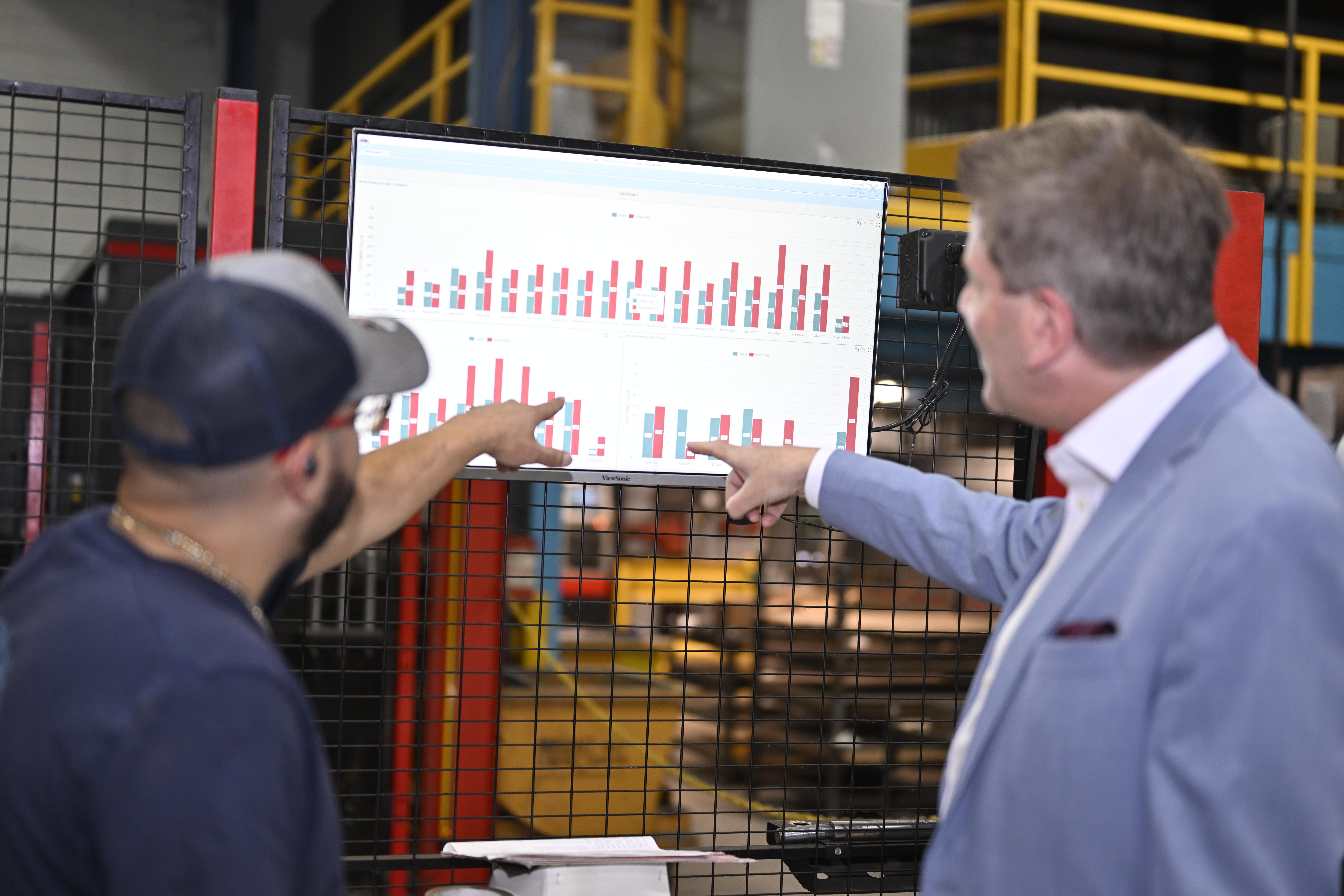
Production software connects to multiple data sources: discrete meters, distributed control systems, programmable logic controllers, and databases. The result is a unified dashboard that visualizes energy usage patterns across electricity, gas, water, steam, and compressed air systems. Advanced algorithms compare historical and real-time usage data to uncover consumption behaviors and predict future energy needs with greater accuracy.
Managers can track usage by machine, cell, production line, or entire facility—displayed in various units across different time periods. Dashboards flag whether operations are running within acceptable zones or whether specific consumption items have crossed thresholds, prompting immediate investigation.
Identifying energy waste across production lines
Most manufacturing facilities have room for 10-20% improvement in energy performance—just by tackling waste. Industrial energy monitoring surfaces several common culprits:
– Idle-state losses: Equipment left running during breaks, shift changes, or weekends accounts for 15-25% of total energy consumption outside production hours.
– Demand spikes: Multiple high-draw machines starting simultaneously can trigger utility penalty charges.
– Equipment inefficiencies: Motors with degraded bearings, misalignment, or poor lubrication draw more current than healthy motors doing identical work.
– Behavioral differences: Different operators running the same machine can produce varying energy consumption figures.
– Compressed air leaks and poor power factor: Additional waste sources that monitoring systems can quantify and pinpoint.
Setting energy benchmarks and alerts
Without benchmarks, waste goes unnoticed. Energy management platforms establish realistic consumption targets for processes and production lines, providing standardized metrics that highlight actual energy-efficiency levels across different machining systems.
Automated notifications alert teams the moment consumption exceeds defined thresholds—enabling quick action before losses accumulate. Variance analysis goes a step further, breaking down cost changes into their root causes: rate increases, consumption shifts, or demand spikes. This turns raw data into a clear picture of where the energy budget is going—and why.
Ways Manufacturing Production Scheduling Software Optimizes Energy Efficiency
Monitoring energy usage is only the first step. What you do with that information is what actually moves the needle on costs. Manufacturing production scheduling software actively optimizes when and how production occurs—analyzing energy pricing structures, equipment capacity, and production requirements to generate schedules that minimize consumption during expensive periods, without compromising output targets.
Load balancing and machine utilization
Not all machines consume energy equally. When multiple machines can handle the same job, production software assigns work to those with lower energy consumption rates—and selectively shuts down idle equipment during low workload periods. The result: you stop paying for capacity you’re not using.
Visual dashboards overlay workload against capacity, surfacing imbalances before they create bottlenecks. Drag-and-drop interfaces make it easy to redistribute work across resources, eliminating overloads on specific machines while underutilized equipment sits idle. Work center capacity, employee skills, tools, and space constraints are all factored in to level-load production across alternative work centers.
Off-peak production scheduling
Time-of-use electricity tariffs mean the same kilowatt-hour can cost significantly more depending on when you use it. Manufacturing production planning software schedules energy-intensive operations during lower-rate periods, aligning high-load activities with favorable pricing windows.
Consider what this looks like in practice:
- HVAC systems precondition spaces overnight, while pumps and compressors run during low-cost energy windows.
- Steel plants shift auxiliary loads—like scrap preheating and water treatment—to off-peak hours, achieving 15-30% reductions in energy costs.
- For a mid-sized facility processing 50,000 tons annually, that translates to $500,000 to $1.5 million in annual savings.
- Steel manufacturers using advanced scheduling solutions report 2 to 5 percent savings.
The math is straightforward. The right schedule doesn’t just keep production on track—it keeps energy bills in check.
Automated equipment shutdown during idle times
Energy consumption doesn’t stop when production does. Machines in idle states, transitioning between shutdown and startup, still draw power. Production scheduling software implements machine on/off control during maintenance periods and production gaps, using algorithms to determine optimal shutdown criteria based on idle duration thresholds and equipment-specific restart requirements.
This directly addresses the 15 to 25 percent of energy consumption that typically occurs outside production hours—waste that’s difficult to spot without the right tools, but straightforward to eliminate once you can see it.
Energy-aware production planning
Modern scheduling isn’t about solving one problem at a time. It addresses multiple objectives simultaneously—minimizing makespan, reducing energy consumption, and balancing machine utilization. Algorithms analyze historical patterns, predict energy prices, and generate optimal production sequences that minimize costs while meeting operational constraints. When conditions change or prices fluctuate, the system monitors and adjusts schedules accordingly.
The goal is a shop floor that runs efficiently not just today, but adapts as conditions evolve.
Reducing Material Waste and Carbon Footprint Through Smart Production
Material waste is a double problem. It hurts the environment—and it hits your bottom line. Manufacturing production software tackles this on multiple fronts, from inventory and quality control to material flow and waste recovery.
Precision inventory management
Too much stock ties up capital and risks obsolescence. Too little causes production delays and missed orders. Effective inventory control finds the balance—and production planning software for manufacturing makes that possible through Just-in-Time principles, ensuring materials arrive exactly when needed.
The results speak for themselves. Food manufacturers using JIT with careful supply chain synchronization have reduced ingredient waste from spoilage by over 80%. Days sales in inventory should average 30 to 60 days, preventing both stockouts and overstocking that leads to obsolescence or expiration. Real-time visibility into stock levels enables timely replenishment while identifying slow-moving items before they become obsolete.
Quality control and defect reduction
Every defective part carries a hidden cost—scrapped raw materials, wasted labor hours, and rework that pulls resources away from productive jobs. Quality control software monitors processes in real-time, catching deviations before they escalate into larger production issues. Automated inspections powered by machine vision detect flaws with greater accuracy than manual checks.
The numbers are significant. Research shows digitizing quality processes has reduced quality deviations by 65% while accelerating productivity between 50% and 100%. Each prevented defect eliminates waste not just from the defective unit itself, but from every resource consumed trying to fix it.
Optimized material flow
What happens between production steps matters just as much as the steps themselves. Inefficient layouts force materials to travel unnecessary distances—adding time, handling costs, and opportunities for damage or loss. Manufacturing production planning software analyzes movement patterns to position workstations and storage in logical sequences. This cellular layout approach minimizes transportation distance and simplifies handling.
Simulation tools go further, identifying bottlenecks where materials wait idly between process steps—enabling redesigns that eliminate non-value-adding time before it becomes a recurring problem.
Recycling and byproduct tracking
Secondary materials account for only 7.2% of global economic inputs—which means most manufacturers are leaving significant recovery opportunities on the table. Production software manufacturing tracks waste streams, byproducts, and recyclable materials throughout operations. These platforms capture detailed transactional data, providing audit trails that support compliance reporting while surfacing opportunities to reuse or repurpose materials. Blockchain-based solutions take this further, offering visibility down to individual waste sources and enabling accurate measurement of diversion rates and carbon impact.
The bottom line: smarter material management isn’t just good environmental practice—it’s good business.
Measuring Sustainability Impact with Production Planning Software for Manufacturing
What gets measured gets managed. That principle applies directly to sustainability—and yet many manufacturers struggle to quantify their environmental impact in a way that satisfies both internal leadership and external regulators. Production planning software for manufacturing closes that gap, turning raw operational data into structured sustainability metrics that mean something.
Carbon emissions tracking
Carbon accounting software measures greenhouse gas emissions across Scope 1, 2, and 3 categories in alignment with the GHG Protocol. Manufacturing production software integrates with energy meters, production systems, and IoT devices to calculate emissions from different activities using industry-specific methodologies.
What separates useful carbon tracking from box-ticking is transparency. Advanced platforms provide:
– Clear emissions factors and transparent calculation logic– Full traceability from source data through to reported figures– Asset-level detail, rather than summary-level estimates that obscure the real picture
Without this level of granularity, it’s nearly impossible to identify where emissions reductions will have the greatest impact.
Sustainability reporting and compliance
The regulatory landscape has shifted significantly. Organizations must now work through thousands of sustainability regulations globally—including the Corporate Sustainability Reporting Directive (CSRD) and California’s SB 253. Missing these requirements isn’t just a reputational risk; it carries real financial consequences.
Manufacturing production planning software supports reporting aligned with widely recognized frameworks such as GRI, SASB, TCFD, and the Science-Based Targets initiative. Rather than manually compiling data from disconnected sources, these platforms automate collection and generate compliance-ready reports—reducing both the time burden and the risk of non-compliance fines.
ROI calculations for energy savings
Energy efficiency investments typically achieve positive ROI within 8-12 months. However, facilities that track only direct energy reduction miss 40-50% of the total value on the table. A complete ROI picture must account for:
– Demand charge management – Maintenance cost reduction – Downtime prevention – Broader production efficiency gains
Focusing narrowly on kilowatt-hours saved undervalues the full return. Production software gives you the data to make that case clearly—to finance teams, stakeholders, and regulators alike.
Continuous improvement metrics
Sustainability KPIs are only useful if they’re measurable, visible, and actionable. Production software manufacturing tracks key metrics—energy consumption, emissions, and waste generation—to set realistic benchmarks and drive ongoing improvements in environmental performance.
Organizations can measure sustainability performance at three distinct levels:
– KPI level: individual metrics tied to specific processes or resources – Pillar level: grouped performance across energy, waste, or emissions categories – General sustainability index: an overall view of the organization’s environmental footprint
This layered approach gives decision-makers the right level of detail for the right conversation—whether that’s a shop floor review or a board-level sustainability report.
Conclusion
Manufacturing production software delivers measurable results through real-time energy monitoring, smart scheduling, and waste reduction. In fact, facilities implementing these systems typically see 5-10% reductions in energy demand alongside significant sustainability improvements. We recommend starting with energy tracking and scheduling optimization, as these create immediate cost savings that fund further initiatives. When you choose the right production software, you’re making a strategic investment that cuts costs while advancing your environmental goals.
FAQs
Q1. How does manufacturing production software help reduce energy costs? Manufacturing production software reduces energy costs through real-time monitoring, smart scheduling, and data-driven optimization. It tracks energy consumption at the machine level, schedules energy-intensive operations during off-peak hours when electricity rates are lower, and automatically shuts down idle equipment. Facilities implementing these systems typically achieve 5-10% reductions in energy demand, with some manufacturers reporting savings of $500,000 to $1.5 million annually.
Q2. What are the main sources of energy waste in manufacturing facilities? Common energy waste sources include idle-state losses when equipment runs during breaks or weekends (accounting for 15-25% of total consumption), demand spikes from multiple machines starting simultaneously, equipment inefficiencies from degraded components, compressed air leaks, and operator behavioral differences. Manufacturing facilities often have room for 10-20% improvement in energy performance by identifying and eliminating these waste sources.
Q3. How does production scheduling software improve sustainability in manufacturing? Production scheduling software improves sustainability by optimizing material flow to reduce waste, implementing precision inventory management that prevents spoilage and obsolescence, enhancing quality control to minimize defects and scrap, and tracking recyclable materials and byproducts throughout operations. These systems also enable carbon emissions tracking and generate compliance-ready sustainability reports aligned with frameworks like GRI, SASB, and TCFD.
Q4. What is the typical return on investment for energy efficiency software in manufacturing? Energy efficiency investments in manufacturing typically achieve positive ROI within 8-12 months. However, facilities tracking only direct energy reduction miss 40-50% of total value. Complete ROI includes demand charge management, maintenance cost reduction, downtime prevention, and production efficiency gains beyond just energy savings.
Q5. How does production software help manufacturers meet sustainability reporting requirements? Production software automates data collection and generates compliance-ready reports aligned with global sustainability frameworks and regulations including CSRD, California’s SB 253, GRI, SASB, and TCFD. It measures greenhouse gas emissions across Scope 1, 2, and 3 categories, provides transparent calculation logic with clear emissions factors, and tracks sustainability KPIs to support continuous improvement and reduce the risk of non-compliance fines.